
Ep. 90 | MRS. AMERICA - ERA & Two Women’s Movements (Part 2/2)
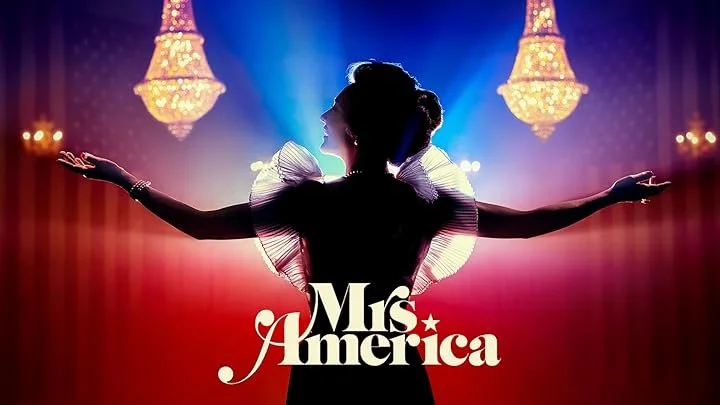
MRS. AMERICA (2020)
Cate Blanchett as Phyllis Schlafly in the FX/Hulu series MRS. AMERICA Photos: FX
Ep. 90 is also available on Apple Podcast | YouTube | iHeartMRS. AMERICA revisits the 1970s women’s rights movement, and the battle over the Equal Rights Amendment (ERA) that sparked two women’s movements that continue to feed the political discourse and its divisions today. The 2020 FX series is the 5th historical drama in the REVOLUTION TO RIGHTS: AMERICA AT 250 miniseries exploring America’s 250-year history of advancing freedom since the Declaration of Independence, which marks the founding of the United States in 1776.
Episode 90 is part 2 of our conversation with historian and author Marjorie J. Spruill about the rise of Phyllis Schlafly’s anti-ERA campaign, which gained traction by engaging influential religious conservatives like Lottie Beth Hobbs of Fort Worth, Texas. Marjorie also talks about the feminists who championed ERA and equal rights for women (in real-life and portrayed in MRS. AMERICA) — Gloria Steinem, Bella Abzug, Shirley Chisholm, Betty Friedan, Jill Rukelshaus, Brenda Feigen-Fasteau and others — and the success of the 1977 National Women’s Conference in Houston, Texas. The National Women’s Conference is a pivotal moment for both pro- and anti- ERA groups creating two women’s movements. Finally Marjorie answers our question about the current status of the Equal Rights Amendment.
Marjorie’s 2017 book Divided We Stand: The Battle Over Women’s Rights and Family Values That Polarized American Politics was a key resource for the stories in MRS. AMERICA.

REVOLUTION TO RIGHTS: AMERICA AT 250
Episode 86 is part of REVOLUTION TO RIGHTS: AMERICA AT 250, a 10-episode podcast series from Historical Drama with The Boston Sisters® that takes you on a journey through America’s 250-year history of advancing freedom and justice since the Declaration of Independence in 1776.
“It was the story of two women’s movements and the growing political activity of women through the 1970s to the point that by 1980 they were voting in larger percentages than men....and we still outvote men, and we are still very divided in terms of how we use our political power.”
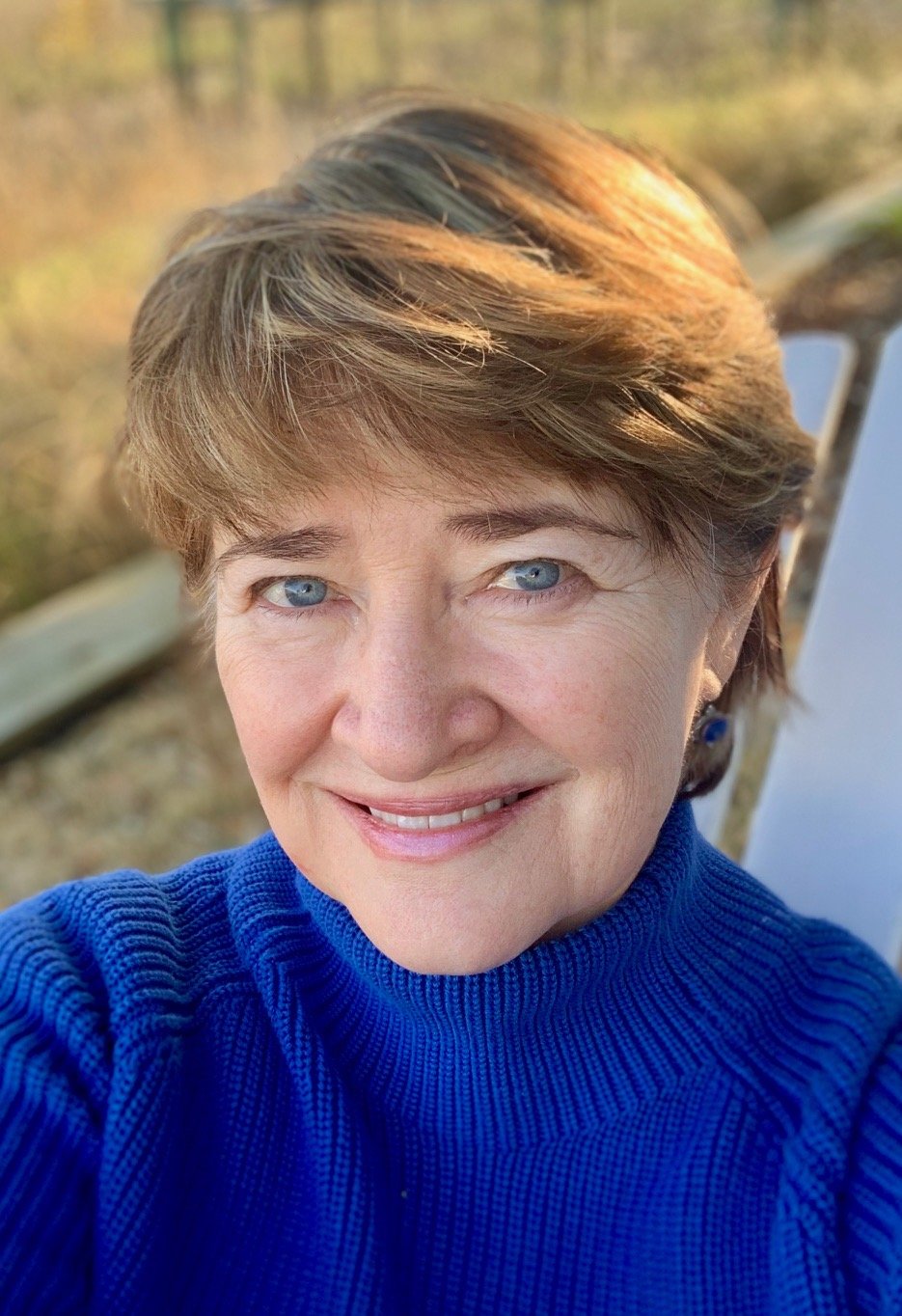
Guest: Marjorie J. Spruill, Ph.D.
Marjorie J. Spruill, Ph.D. is Distinguished Professor Emerita at the University of South Carolina. Marjorie specializes in United States history, particularly women's and gender history and the history of the American South. She gives frequent addresses on woman suffrage and modern feminism and anti-feminism, and serves as a consultant for documentaries and to the media.
Marjorie is the author of Divided We Stand: The Battle Over Women's Rights and Family Values That Polarized American Politics (Bloomsbury Publishing); New Women of the New South: The Leaders of the Woman Suffrage Movement in the Southern States (Oxford University Press) and the editor of One Woman, One Vote: Rediscovering the Women’s Suffrage Movement (NewSage Press); VOTES FOR WOMEN! The Woman Suffrage Movement in Tennessee, the South, and the Nation (University of Tennessee Press).
She is co-editor of The South in the History of the Nation: A Reader (Bedford/St. Martin's); the three-volume anthology South Carolina Women: Their Lives and Times, (University of Georgia Press), and a two-volume Mississippi Women: Their Histories, Their Lives.
Marjorie J. Spruill has served as a member of the Executive Committee of the Southern Historical Association, and president of the Southern Association for Women Historians. She has served on the Editorial Board of the Journal of Southern History, and has previously served on the editorial board of the Journal of American Studies, the journal of the British Association for American Studies (BAAS). She was a fellow at the Radcliffe Institute for Advanced Study at Harvard University in 2006-2007. In 2010-2011 she was a Fellow at the Woodrow Wilson International Center for Scholars. In 2011-2012 she had a fellowship from the National Endowment for the Humanities, and was a Resident Associate at the National Humanities Center. Her work has also been supported by the Gerald R. Ford Presidential Foundation. She received her M.A. and Ph.D. from the University of Virginia. Majorie is currently chair of the Scholars Advisory Council of the National Women’s History Museum.
Connect with Marjorie J. Spruill: Facebook

USE YOUR POWER!
The National Association of Secretaries of State (NASS) “Can I vote?” website is a resource to…
Check your voting status
Find your polling place
Register to vote
This nonpartisan website was created by state election officials to help eligible voters figure out how and where to go vote. Can I Vote does not capture any information, but instead links directly to state election websites and trusted resources. Source: NASS
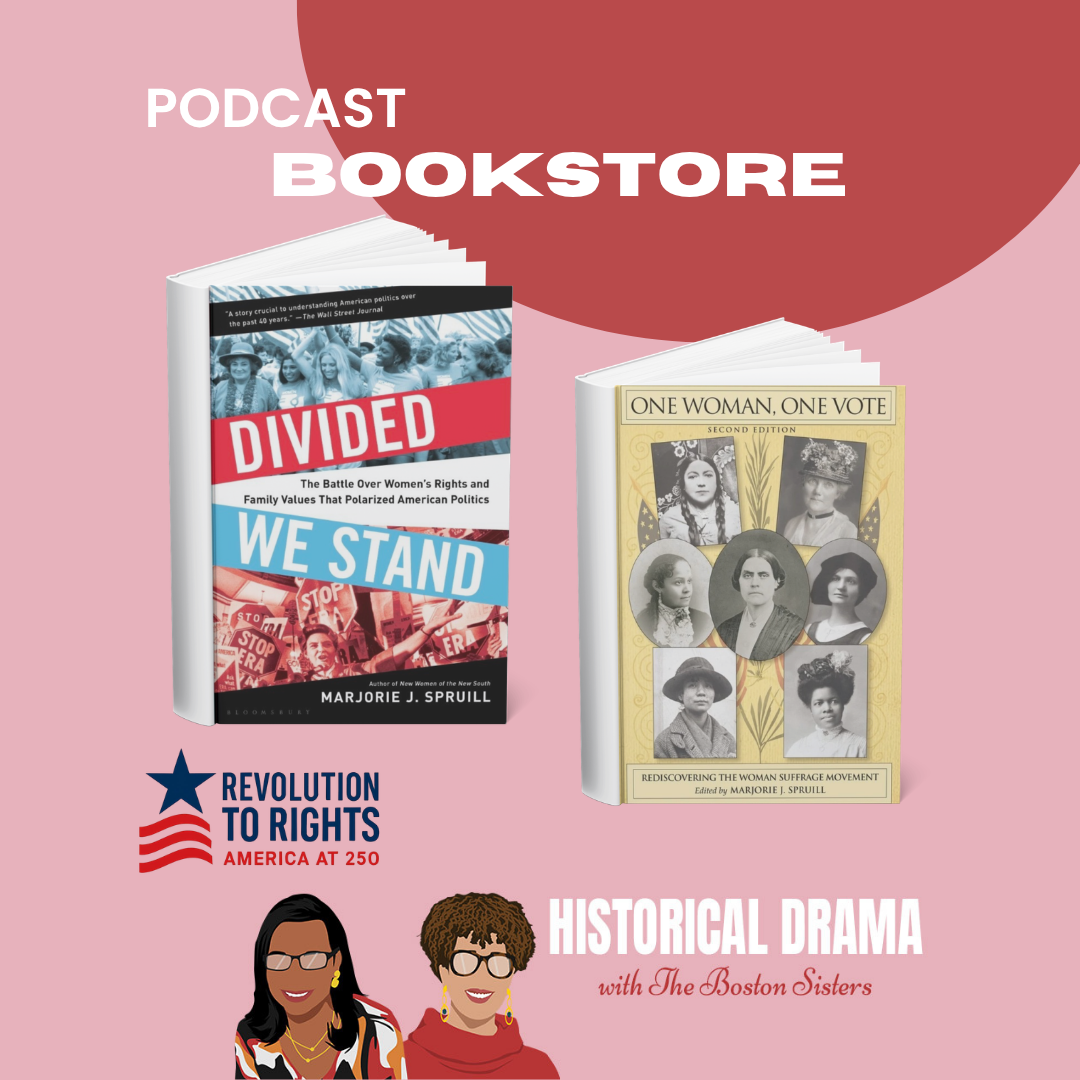
TAKE A DEEPER DIVE INTO THIS PODCAST!
Visit our affiliate bookstore REVOLUTION TO RIGHTS bookshelf for books about the historic quest for freedom for all people in the U.S. We’ll update the shelf to include books for all ages.
Purchase other titles from past podcasts on the MBGLtd affiliate page on bookshop.org. Your book purchases support independent booksellers and a small commission supports Historical Drama with The Boston Sisters®.
MRS. AMERICA
MRS. AMERICA (2020) First Look trailer
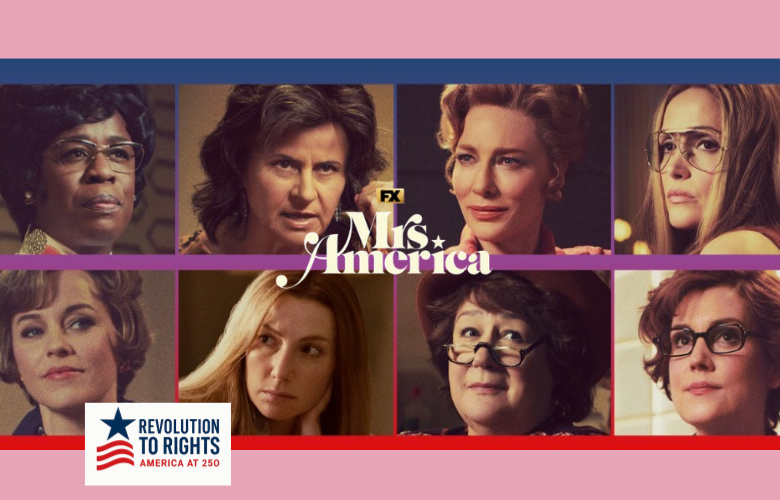
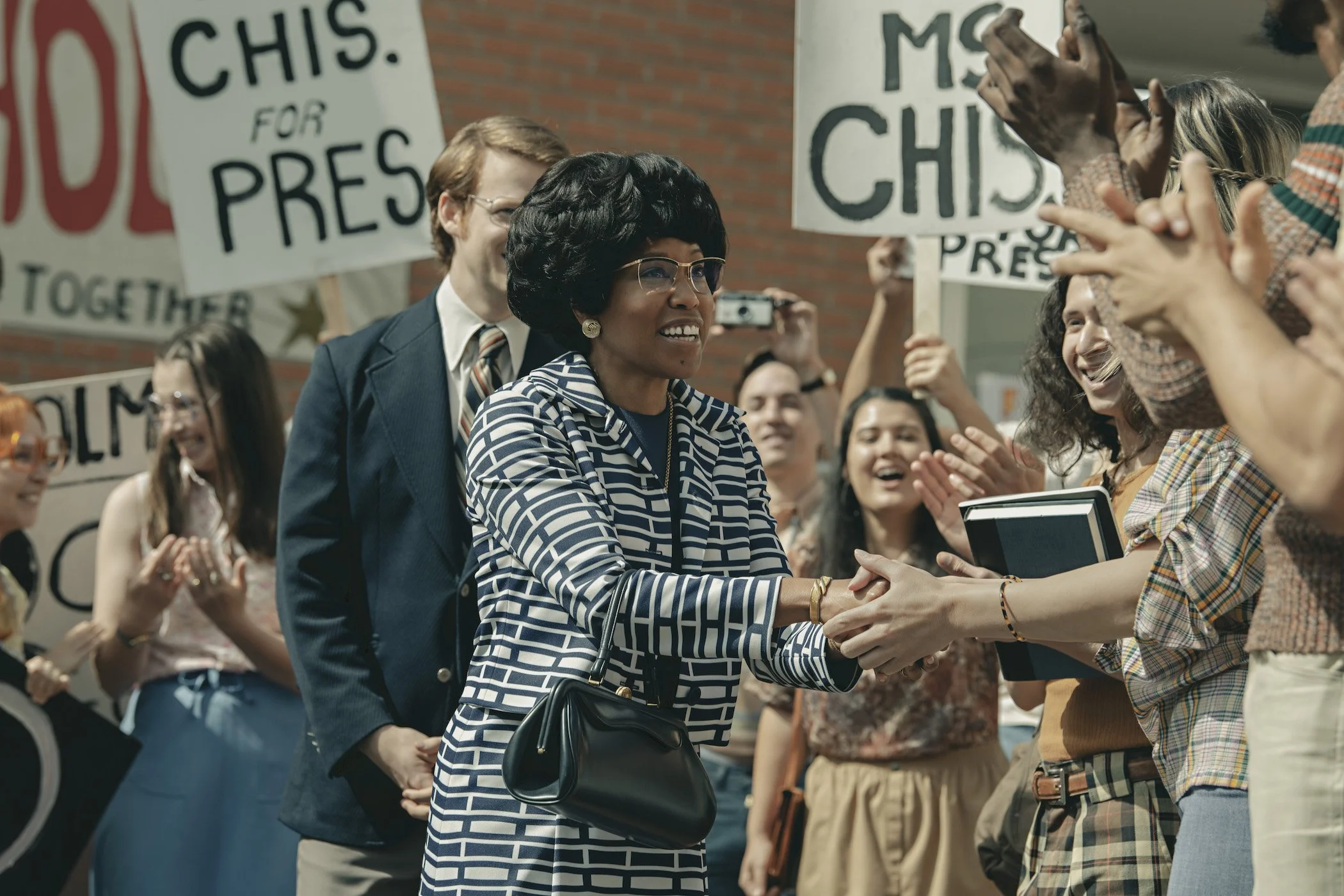
MRS. AMERICA tells the story of the movement to ratify the Equal Rights Amendment (ERA), and the unexpected backlash led by a conservative woman named Phyllis Schlafly. Through the eyes of the women of the era – both Schlafly and second wave feminists Gloria Steinem, Betty Friedan, Shirley Chisholm, Bella Abzug and Jill Ruckelshaus – the series explores how one of the toughest battlegrounds in the culture wars of the 1970s shifted the political landscape for generations.
Featured in the MRS. AMERICA miniseries as the real-life figures from the ERA battle are Cate Blanchett (Phyllis Schlafly), Rose Byrne (Gloria Steinem), Uzo Aduba (Shirley Chisholm), Margo Martindale (Bella Abzug), Elizabeth Banks (Jill Ruckelshaus), Tracey Ullman (Betty Friedan), Ari Graynor (Brenda Feigen-Fasteau), also Melanie Lynskey (Rosemary Thomson), John Slattery (Fred Shlafly), Niecy Nash (Florynce “Flo” Kennedy), and Cindy Drummond as Lottie Beth Hobbs. Dahvi Waller (MAD MEN) is the creator and an executive producer. Source: FX
MRS. AMERICA is streaming on Hulu (for subscribers). Do a search for additional streaming services offering the miniseries.
The Equal Rights Amendment (ERA)
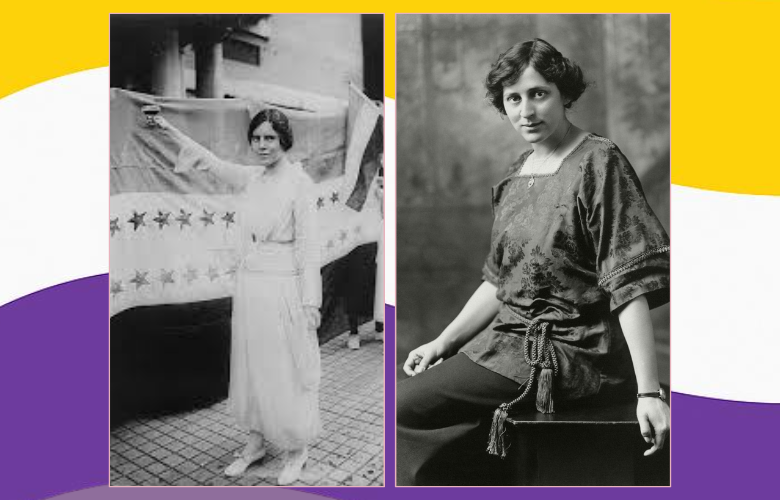
Alice Paull (left) and Crystal Eastman (right) Photos: Library of Congress
“The Equal Rights Amendment was first drafted in 1923 by two leaders of the women’s suffrage movement, Alice Paul (1885 - 1977)and Crystal Eastman (1881 - 1928). For women’s rights advocates, the ERA was the next logical step following the successful campaign to win access to the ballot through the adoption of the 19th Amendment. They believed that enshrining the principle of gender equality in our founding charter would help overcome many of the obstacles that kept women as second-class citizens.
While the text of the amendment has changed over the years, the gist of it has remained the same. The version approved by Congress in 1972 and sent to the states reads:
“Equality of rights under the law shall not be denied or abridged by the United States or by any state on account of sex.”
Learn more about the Equal Rights Amendment (ERA) and its current status on NYU Law’s Brennan Center for Justice’s webpage, “The ERA Explained.” (Source)
1977 National Women’s Conference in Houston, Texas
On the weekend of November 18-21, nearly 20,000 convened in Houston, Texas for the National Women’s Conference in 1977. The conference was authorized by public law and the first women’s conference supported by federal funds. The National Women’s Conference was organized at the 1975 United Nations conference in Mexico City celebrating the "International Year of the Woman," which extended to the International Decade of the Woman from 1975 - 1985. At the time of the 1977 conference, the ERA was 3 states short of ratification. Source and more information: Texas State Historical Association